
MOQ: 500 KG | Bulk & Export Supply Only
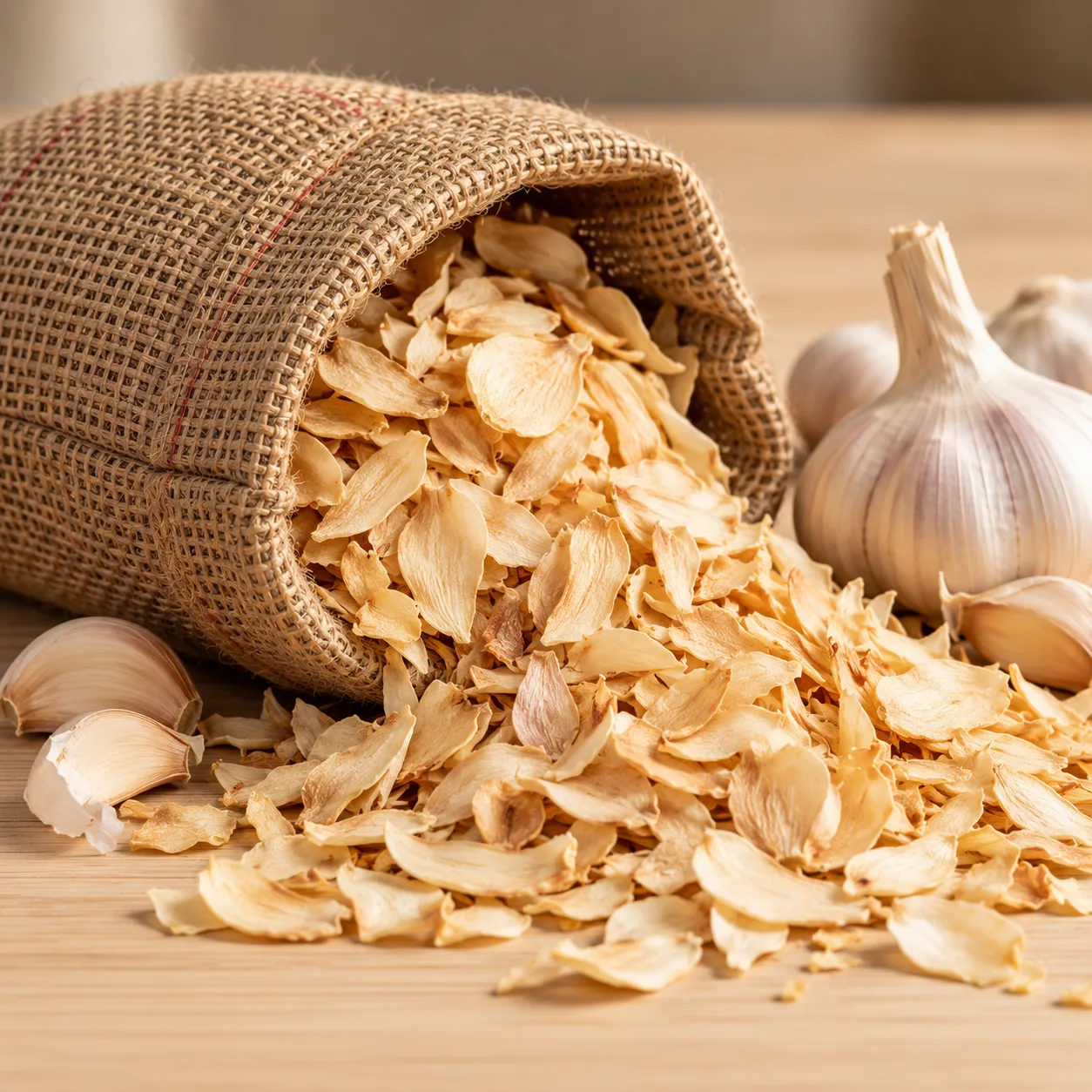
Dehydrated garlic flakes are used in food manufacturing applications where visible garlic texture is valued — including ready meals, instant soups, pasta sauces, pizza toppings, seasoning blends, processed meat products, frozen foods, and garlic bread preparations. The flakes rehydrate during cooking, releasing garlic flavor gradually throughout the preparation process.
For instant soups, ready meals, frozen meals, and microwaveable products where visible garlic flakes add texture and authenticity to the final dish.
For specialty seasoning mixes, garlic-heavy spice blends, and dry rubs where garlic flakes provide visual identity and texture alongside powder components.
For pizza toppings, pasta sauces, and Italian-style food products where visible garlic pieces are an expected visual element of the product.
For garlic bread, focaccia, savory baked goods, and stuffed bread products where garlic flakes are embedded in the dough or sprinkled as a topping.
Every specification choice involves trade-offs. Understanding these trade-offs helps you specify requirements that match your actual application needs rather than defaulting to “tightest possible” specifications that may increase cost without benefit.
Uniform slice thickness ensures consistent rehydration across all flakes in a batch. Uneven slices result in some flakes remaining under-hydrated while others become soft — affecting texture and flavor distribution. Confirm slice thickness specification before bulk ordering.
Garlic flakes are more sensitive to moisture than powder due to their larger surface area and cut structure. Moisture content above 7% accelerates microbial growth and reduces shelf life. Verify moisture content in every batch through the CoA and ensure proper storage conditions.
Garlic is prone to darkening during drying. Properly processed flakes maintain an off-white to light cream color. Dark flakes indicate overheating or prolonged drying. Color consistency matters for products where appearance is part of the quality perception.
Excessive broken flake content produces powder-like fragments alongside intact flakes, leading to inconsistent texture in your finished product. Check the broken flake percentage in the specification sheet and CoA. Higher broken flake content may be acceptable for applications where the product will be further processed.
Based on our experience with United States buyers, these are the most common sourcing mistakes that lead to disputes, rejections, or quality issues:
Our MOQ ensures commercial-grade production economics, consistent quality across batches, and competitive pricing for bulk buyers. Smaller sample orders can be arranged for quality evaluation.
We don’t publish fixed prices because fixed prices in agricultural commodity trading often lead to disputes, unfulfilled expectations, and buyer dissatisfaction. Here’s why requirement-based quotations work better for serious commercial buyers:
Exporting to United Kingdom requires compliance with FSA (Food Standards Agency) regulations. We provide comprehensive documentation support to facilitate smooth customs clearance and regulatory compliance.
Exporting to United States requires compliance with FDA (Food and Drug Administration) regulations. We provide comprehensive documentation support to facilitate smooth customs clearance and regulatory compliance.
Exporting to Australia requires compliance with DAFF (Department of Agriculture, Fisheries and Forestry) regulations. We provide comprehensive documentation support to facilitate smooth customs clearance and regulatory compliance.
Exporting to UAE requires compliance with ESMA (Emirates Authority for Standardization & Metrology) regulations. We provide comprehensive documentation support to facilitate smooth customs clearance and regulatory compliance.
Exporting to Canada requires compliance with CFIA (Canadian Food Inspection Agency) regulations. We provide comprehensive documentation support to facilitate smooth customs clearance and regulatory compliance.
Note: Documentation requirements may vary based on your specific product use and import license. We recommend confirming requirements with your customs broker before placing orders.
Agricultural products have inherent variability. Our quality control processes aim to minimize this variability while being transparent about what can and cannot be guaranteed.
Every production batch is tested for physical, chemical, and microbiological parameters before shipment approval.
Moisture content and particle size are monitored throughout production to ensure specifications are met consistently.
Pre-shipment samples can be provided for buyer verification to ensure production batch matches expected quality.
Once specifications are established, repeat orders follow documented specifications to maintain quality consistency.
Our Commitment: Full transparency in documentation — every shipment is accompanied by batch-specific test reports and quality records.
Finely ground dehydrated onion that dissolves instantly in liquids and blends uniformly into any formulation. Best suited for smooth sauces, gravies, seasoning mixes, processed foods, and coating applications where a consistent, invisible texture is required. Offers fast flavor release and easy handling in high-speed mixing operations.
Small cut pieces of dehydrated onion that retain visible texture in the final product. Best suited for soups, ready meals, stuffed breads, and applications where minced onion pieces add visual appeal and gradual flavor release during cooking. Requires adequate cooking time for proper rehydration.
Our standard dehydrated garlic flakes are 5–15 mm in slice size. Custom flake sizes can be arranged based on your application requirements. Flake size specifications are documented in the Certificate of Analysis for each batch.
Garlic flakes are thin-cut slices that retain visible texture and release flavor gradually during cooking. Garlic powder is finely ground, dissolves instantly, and provides uniform flavor distribution. Flakes are preferred when visible garlic pieces are desired in the final product.
Yes, our garlic flakes rehydrate during normal cooking processes. Rehydration time depends on the cooking temperature and liquid content of your application. The slices are cut thin enough to rehydrate completely in typical food manufacturing processes including soups, sauces, and ready meals.
The shelf life is typically 24 to 36 months from manufacture date when stored in cool, dry conditions (15–25°C, <65% RH). Proper storage is important — flakes are more sensitive to moisture than powder due to their larger surface area.
Yes, custom flake sizes can be arranged within our manufacturing capabilities. Standard range is 5–15 mm. Specific flake size requirements should be discussed during inquiry so we can confirm feasibility and pricing.
Some broken flake content is normal in dehydrated garlic flakes. The acceptable broken flake percentage is specified in the product specification sheet and CoA. If your application requires low broken flake content, please mention this during inquiry.
No. Our dehydrated garlic flakes are 100% pure garlic — no additives, preservatives, or anti-caking agents. The product is produced from fresh garlic bulbs that are sliced and dried under controlled conditions.
Yes, garlic flakes are used in seasoning blends where visible garlic texture is part of the product identity. They are often blended with garlic powder to combine texture and uniform flavor distribution in the same seasoning mix.