
MOQ: 500 KG | Bulk & Export Supply Only
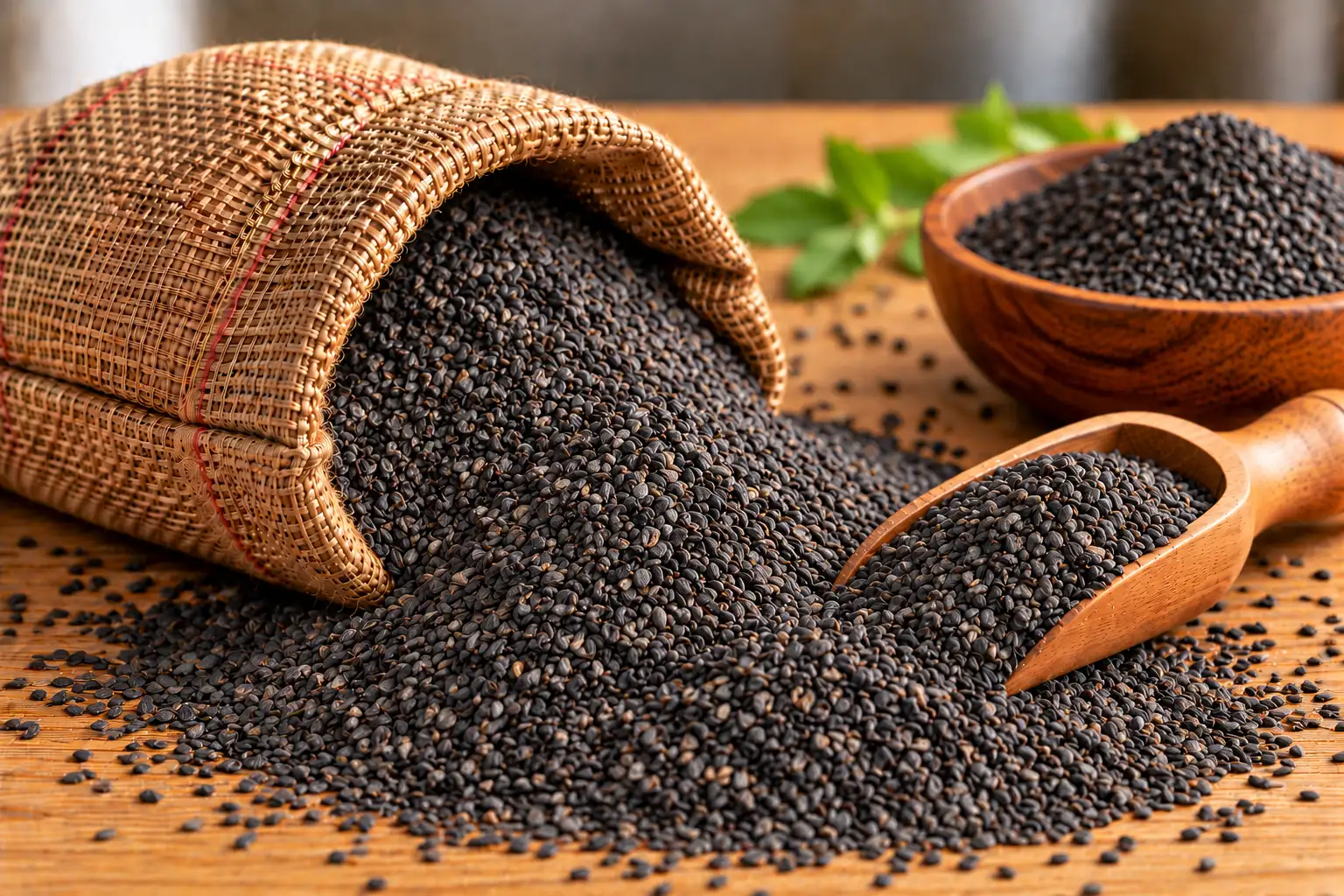
Black sesame seeds are used across food manufacturing and specialty applications including bakery products (bread, buns, crackers, cookies), confectionery, tahini and pastes, Japanese and Korean cuisine preparations, seasoning blends, snack coatings, oil extraction, and health-focused food products. The distinctive dark color and robust flavor make black sesame particularly valuable for products targeting premium or health-conscious consumer segments.
For specialty bread, bun, cracker, cookie, and pastry manufacturers who use black sesame seeds as a topping, coating, or dough ingredient. The dark color creates visual contrast and premium appearance on bakery products.
For manufacturers producing Japanese and Korean-style products including gomasio (sesame salt), kinako (sesame powder), sesame oil, and traditional confectionery where black sesame is a culturally specific and valued ingredient.
For health food manufacturers, organic food brands, and premium product lines that highlight the higher calcium and mineral content of black sesame as a nutritional selling point.
For confectionery producers and snack manufacturers who use black sesame seeds in sweet and savory products including sesame brittle, halva, energy bars, and seasoned snacks where the robust flavor and dark appearance add product differentiation.
Every specification choice involves trade-offs. Understanding these trade-offs helps you specify requirements that match your actual application needs rather than defaulting to “tightest possible” specifications that may increase cost without benefit.
Black sesame seeds should have uniform dark brown to black color across the batch. Mixed-color seeds (light brown or grey) indicate poor sorting or mixed origin. Uniform color is important for products where visual appearance matters. Check color grading in the specification sheet.
Black sesame should have a robust, nutty flavor with a slight natural bitterness from the bran layer. Excessive bitterness or off-flavors indicate old stock, improper drying, or storage damage. Conduct sensory evaluation before bulk orders to confirm the flavor profile matches your requirements.
Black sesame seeds must be thoroughly cleaned to remove sand, dust, damaged seeds, and foreign matter. The unhulled nature of black sesame makes thorough cleaning even more critical. Check the purity percentage and foreign matter content in the specification sheet and CoA.
Black sesame seeds have high oil content and are prone to rancidity when stored in warm, humid conditions. Moisture above 7% increases mold and rancidity risk. Verify moisture content in every batch and ensure your storage conditions are cool and dry with proper ventilation.
Based on our experience with United States buyers, these are the most common sourcing mistakes that lead to disputes, rejections, or quality issues:
Our MOQ ensures commercial-grade production economics, consistent quality across batches, and competitive pricing for bulk buyers. Smaller sample orders can be arranged for quality evaluation.
We don’t publish fixed prices because fixed prices in agricultural commodity trading often lead to disputes, unfulfilled expectations, and buyer dissatisfaction. Here’s why requirement-based quotations work better for serious commercial buyers:
Exporting to United Kingdom requires compliance with FSA (Food Standards Agency) regulations. We provide comprehensive documentation support to facilitate smooth customs clearance and regulatory compliance.
Exporting to United States requires compliance with FDA (Food and Drug Administration) regulations. We provide comprehensive documentation support to facilitate smooth customs clearance and regulatory compliance.
Exporting to Australia requires compliance with DAFF (Department of Agriculture, Fisheries and Forestry) regulations. We provide comprehensive documentation support to facilitate smooth customs clearance and regulatory compliance.
Exporting to UAE requires compliance with ESMA (Emirates Authority for Standardization & Metrology) regulations. We provide comprehensive documentation support to facilitate smooth customs clearance and regulatory compliance.
Exporting to Canada requires compliance with CFIA (Canadian Food Inspection Agency) regulations. We provide comprehensive documentation support to facilitate smooth customs clearance and regulatory compliance.
Note: Documentation requirements may vary based on your specific product use and import license. We recommend confirming requirements with your customs broker before placing orders.
Agricultural products have inherent variability. Our quality control processes aim to minimize this variability while being transparent about what can and cannot be guaranteed.
Every production batch is tested for physical, chemical, and microbiological parameters before shipment approval.
Moisture content and particle size are monitored throughout production to ensure specifications are met consistently.
Pre-shipment samples can be provided for buyer verification to ensure production batch matches expected quality.
Once specifications are established, repeat orders follow documented specifications to maintain quality consistency.
Our Commitment: Full transparency in documentation — every shipment is accompanied by batch-specific test reports and quality records.
Finely ground dehydrated onion that dissolves instantly in liquids and blends uniformly into any formulation. Best suited for smooth sauces, gravies, seasoning mixes, processed foods, and coating applications where a consistent, invisible texture is required. Offers fast flavor release and easy handling in high-speed mixing operations.
Small cut pieces of dehydrated onion that retain visible texture in the final product. Best suited for soups, ready meals, stuffed breads, and applications where minced onion pieces add visual appeal and gradual flavor release during cooking. Requires adequate cooking time for proper rehydration.
Black sesame seeds are unhulled — the outer bran layer is intact, giving them a dark brown to black color, robust nutty flavor with slight bitterness, and higher calcium and mineral content. White sesame seeds are hulled — the bran layer is removed, giving them an ivory-white color, milder sweeter flavor, and lower fiber content. Both have high oil content but serve different flavor and visual purposes.
Black sesame seeds are unhulled — the outer bran layer is intentionally left intact. This is what gives them their characteristic dark color, robust flavor, and higher nutritional value (especially calcium). If you require hulled sesame seeds, we supply white sesame which is fully hulled.
Black sesame seeds typically contain above 40% oil content. The oil content is documented in the Certificate of Analysis for each batch. The unhulled bran layer contributes to the overall oil and nutrient profile, making black sesame suitable for oil extraction and specialty food applications.
The shelf life is typically 12 to 18 months from the date of packing when stored in cool, dry conditions (15–25°C, <65% RH) in airtight packaging. Black sesame seeds are prone to rancidity due to their high oil content and unhulled bran layer — proper storage is essential.
Black sesame seeds can be used for tahini production, producing a darker-colored sesame paste with a more robust, slightly bitter flavor compared to white sesame tahini. White sesame is the standard for commercial tahini due to its milder flavor and lighter color. Black sesame tahini is used in specialty and premium applications.
Black sesame seeds are used in bakery (bread, crackers, biscuits), confectionery (sesame brittle, halva), Japanese and Korean cuisine (gomasio, kinako), seasoning blends, snack coatings, and oil extraction. The dark color and robust flavor make them particularly valued in specialty and premium food products.
Yes, aflatoxin testing is part of our quality control process. Aflatoxin test results are documented in the CoA for every batch. We source from suppliers who follow proper drying, cleaning, and storage practices to minimize aflatoxin risk.
Yes, custom sorting, sizing, and purity specifications can be arranged based on your requirements. Standard black sesame is sorted for uniform color and cleanliness. Specific requirements for seed size, color grade, or purity should be discussed during inquiry so we can confirm feasibility and pricing.